Discipline and boundaries, according to the Bible, are not just about correcting behavior but about shaping hearts and guiding children toward spiritual growth. Discipline comes from love, as seen in Proverbs 3:12, and is meant to teach, not punish. Boundaries create structure and safety, helping children feel secure and loved while preparing them for life’s challenges. Key principles include:
- Discipline as Love: It’s about addressing heart-level issues, not just outward behavior (Hebrews 12:6, Proverbs 13:24).
- Boundaries for Security: Clear limits protect children and guide them toward wisdom and self-control (Proverbs 4:23, Hebrews 12:11).
- Balance in Parenting: Avoid provoking or exasperating children (Ephesians 6:4). Pair discipline with love, grace, and truth.
- Heart-Focused Approach: Aim for transformation, not just compliance. Correct rebellion with consequences but guide mistakes with patience.
Parents are called to follow God’s example by combining firm boundaries with compassion, ensuring discipline nurtures growth and strengthens relationships. Clear expectations, consistent consequences, and unconditional love create a home where children thrive spiritually and emotionally.
What the Bible Says About Discipline
Discipline Shows Love
The Bible teaches that discipline is more than just correction – it’s an expression of love. Proverbs 3:12 states, "The Lord disciplines those he loves, as a father the son he delights in" [3]. This verse highlights that genuine care often involves guiding someone away from harmful behaviors. Similarly, Proverbs 13:24 warns that neglecting discipline reflects a lack of love, while proper correction demonstrates deep concern [7].
Biblical discipline isn’t about reacting out of frustration. Instead, it’s about addressing deeper heart issues and steering children away from destructive paths. God’s discipline, as described in Hebrews 12:10, is "for our good, that we may share in his holiness." Parents are encouraged to follow this example by offering loving correction that nurtures growth. While discipline may feel painful at the moment, it often serves a greater purpose. As C.S. Lewis once wrote, "Pain insists upon being attended to. God whispers in our pleasures, speaks in our conscience, but shouts in our pain: it is his megaphone to rouse a deaf world" [7].
Bible Verses on Discipline
Several Bible passages provide insight into the purpose and practice of discipline. Hebrews 12:11 reminds us that although discipline may be uncomfortable, it ultimately produces lasting character. Ephesians 6:4 emphasizes the importance of pairing discipline with gentle instruction [1][7]. Proverbs 22:15 highlights how discipline can drive folly from a child’s heart, while Proverbs 23:13–14 portrays it as a way to protect children from harm.
Biblical discipline often involves two key elements: setting firm consequences (yasar) and offering corrective guidance (yakach) [2]. This balanced approach ensures that discipline addresses not just outward behavior but also the underlying issues, fostering meaningful and lasting change.
Discipline Should Change the Heart
The ultimate goal of biblical discipline is heart transformation, not merely stopping bad behavior. Will Spokes from Tenth Presbyterian Church explains, "The Bible teaches that the value of discipline lies in its power to rescue, to work backwards from behavior to the heart" [8]. This approach shifts the focus from temporary compliance to fostering genuine, heartfelt obedience.
Strong relationships are essential for effective discipline. As June Hunt wisely observes, "Rules without relationship lead to rebellion" [5]. Discipline, when combined with love, patience, and care, helps shape a child’s character without crushing their spirit. This nurturing process guides children toward a deeper understanding of obedience and a lifelong commitment to following Christ.
Healthy Discipline: Balancing Love and Limits
What the Bible Says About Boundaries
Biblical boundaries serve as safeguards for relationships, encourage holiness, and promote self-control – a quality described as a fruit of the Spirit in Galatians 5:23 [9].
Dr. John Townsend, a psychologist and author, highlights the lasting impact of boundaries:
"Children who experience a household of clear and appropriate boundaries, delivered with love and warmth, are much better equipped to meet the demands of reality over their lifespan" [9].
When parents set healthy limits, they’re not just managing their children’s behavior – they’re preparing them to face life’s challenges with wisdom and sound judgment.
Where Boundaries Come From in Scripture
The idea of boundaries is woven throughout Scripture, starting with the Garden of Eden. In Genesis 2:16–17, God gave Adam and Eve freedom within defined limits, a boundary meant to protect them [11].
Proverbs 4:23 advises believers to "keep your heart with all vigilance", emphasizing personal responsibility and teaching the distinction between oneself and others [9]. Similarly, Proverbs 25:28 compares a person lacking self-control to "a city broken into and left without walls", underscoring the protective role of boundaries [7]. In Hebrews 12:5–11, God’s discipline is shown as a way to set boundaries for those He loves, resulting in a "harvest of righteousness and peace" [3][10].
As Bible.org explains:
"The commandments of God’s Word are not designed to take away our fun and make life miserable. Rather, they are designed to bring safeguards that enhance our capacity for blessing" [13].
This biblical framework naturally leads to practical ways for parents to implement these principles in their own homes.
How to Set Boundaries as a Parent
Just as Scripture provides clear boundaries for believers, parents can translate these principles into practical, actionable rules. Setting boundaries takes thoughtfulness and clarity. The Four-Step Framework offers a helpful guide: start with Love (unconditional care), express the Truth (clear, simple rules), allow Freedom (the child’s choice to comply), and enforce Reality (consistent consequences) [9].
Start by creating a straightforward list of household rules – such as expectations for chores, respectful communication, and technology use – and place it somewhere visible, like the refrigerator [9][4]. For technology, treat access to devices as a privilege tied to responsible behavior [9]. For communication, insist on respectful language, following Ephesians 6:4, which warns against provoking anger in children [14]. For friendships, teach kids how to say "no" to harmful peer influences and unhelpful behaviors [9].
Dr. John Townsend explains:
"Boundaries help [children] know how to play appropriately, instead of intruding on others’ space. They also help them say no to those wrong kinds of kids and habits that aren’t good for them" [9].
Make sure to clearly outline consequences in advance. For instance, explain that crossing a boundary – like misusing technology – will result in losing access to devices or missing out on playdates. This approach connects choices with outcomes, helping children understand responsibility without the need for repeated warnings or outbursts [9][5].
How to Enforce Boundaries with Compassion
Enforcing boundaries requires a balance of firmness and compassion, reflecting God’s example. Avoid reacting emotionally or out of frustration. If you feel anger building, take a moment to cool down before addressing the situation [5][4]. June Hunt, author and founder of Hope for the Heart, shares this advice:
"A parent’s goal is to shape the will of the child without breaking the spirit" [5].
Whenever possible, correct your child privately to prevent embarrassment. Support them publicly, but address issues in private to maintain trust [5]. After a consequence has been carried out and emotions have settled, offer a hug and verbal reassurance of your love. This step mirrors how God disciplines and restores those He loves.
Parents should also model the behavior they expect. For example, if you limit your child’s screen time, follow the same rule yourself [12]. As children grow, involve them in discussions about boundaries, allowing them to express their needs. This approach builds mutual respect and teaches them to honor the boundaries of others [12]. Ultimately, boundaries established in childhood help children develop internal self-discipline, preparing them to make wise, Christ-centered decisions as they mature [9][10].
sbb-itb-596b85d
Using Biblical Discipline and Boundaries in Difficult Situations
Biblical Discipline vs Consequences vs Enabling: A Parent’s Guide
Parenting Through Family Challenges
In tough times, biblical discipline and clear boundaries can help parents navigate crises while demonstrating godly love. Whether dealing with addiction, trauma, or emotional struggles within the family, maintaining these principles can feel daunting but is essential. Parents need to discern between willful defiance – deliberate rebellion – and childish irresponsibility, which often stems from forgetfulness, immaturity, or difficulty managing frustration. This distinction becomes especially important when children are grappling with trauma or emotional challenges [4].
Josh Mulvihill, Ph.D., Executive Director of Church and Family Ministry at Renewanation, highlights the importance of discipline in protecting and guiding children:
"Discipline is the tool God has given parents to deal with a child’s sin and save a child’s soul" [15].
In moments of crisis, discipline serves as a way to redirect children from harmful behaviors, like addiction, before they spiral further [2]. Boundaries, when set with love, communicate care and protection.
The focus should always be on heart transformation, not just outward behavior. Janel Breitenstein, an author and FamilyLife contributor, explains:
"Our goal in Christian discipline isn’t to create little Pharisees who meticulously groom outside behavior… Instead of just focusing on the behavior, we ask questions to help kids get honest about their hearts" [6].
For children dealing with trauma or addiction, creating a discipline profile can be a game-changer. This involves identifying their preferences, love language, and triggers, such as hunger or overstimulation. Tailoring consequences to their specific needs helps reach their hearts rather than merely sparking frustration [6]. Tools like verbal redirection – for example, saying, "You can try that again, but this time with respect" – give children an opportunity to practice better responses [16].
These practices lay the groundwork for understanding how discipline, consequences, and enabling differ in their impact on family dynamics.
The Difference Between Discipline, Consequences, and Enabling
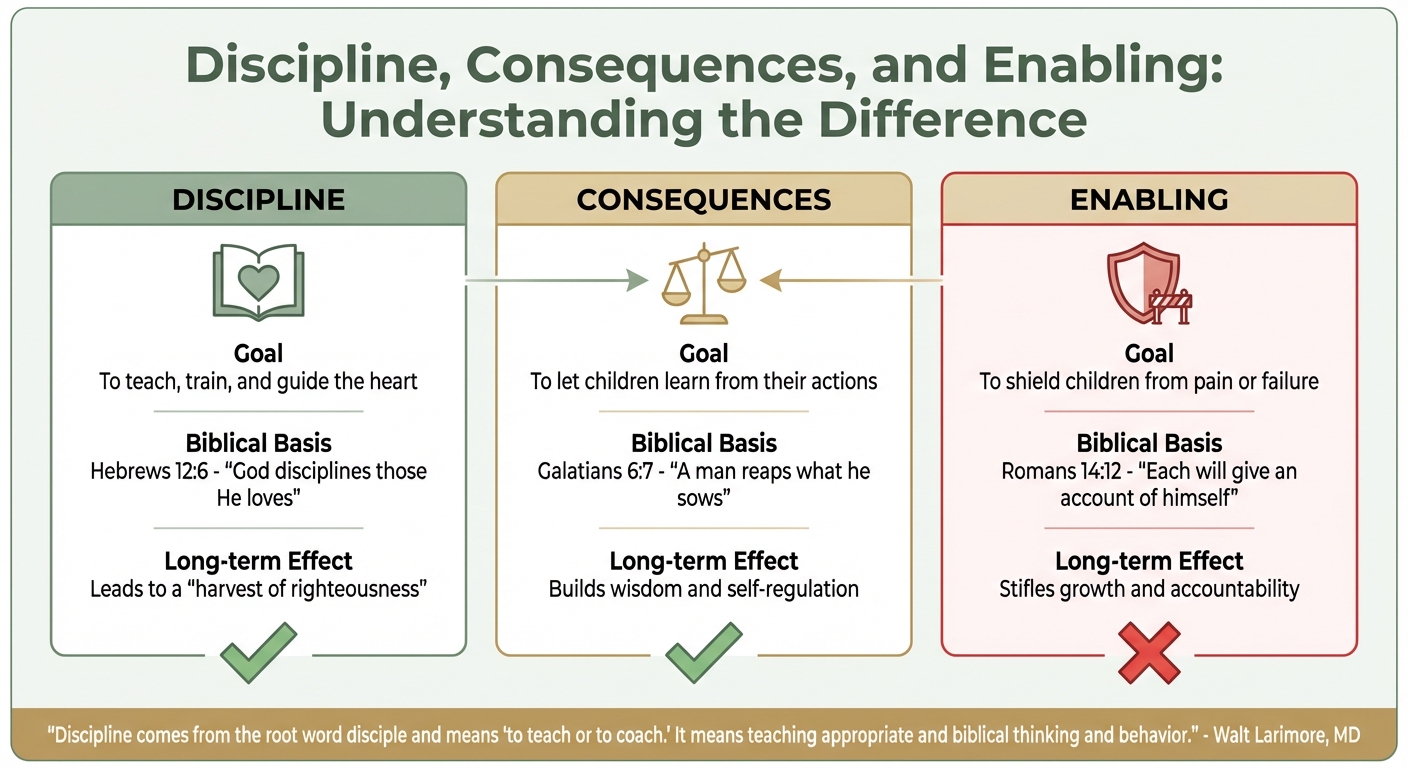
Knowing the difference between discipline, consequences, and enabling is crucial for responding effectively to difficult situations. Each approach serves a distinct purpose:
- Biblical discipline proactively teaches and guides a child’s heart.
- Consequences allow children to learn from the natural outcomes of their choices.
- Enabling prevents growth by shielding children from the results of their actions.
The table below summarizes these approaches:
| Approach | Goal | Biblical Basis | Long-term Effect |
|---|---|---|---|
| Discipline | To teach, train, and guide the heart [16][6] | Hebrews 12:6 ("God disciplines those He loves") [3] | Leads to a "harvest of righteousness" [3] |
| Consequences | To let children learn from their actions [11] | Galatians 6:7 ("A man reaps what he sows") [11] | Builds wisdom and self-regulation [11] |
| Enabling | To shield children from pain or failure [5] | Romans 14:12 ("Each will give an account of himself") [5] | Stifles growth and accountability [5] |
As Walt Larimore, MD, a family physician and author, explains:
"Discipline comes from the root word disciple and means ‘to teach or to coach.’ It means teaching appropriate and biblical thinking and behavior" [4].
In contrast, enabling removes accountability. Scripture reminds us that allowing individuals to face the consequences of their responsibilities is a form of respect for their accountability to God (Romans 14:12) [5]. For example, when parents bail children out of self-created problems or cover for their missed responsibilities, they inadvertently block opportunities for the child to grow in wisdom and self-control.
Understanding these distinctions is essential before seeking outside support.
Getting Help as a Christian Parent
Sometimes, biblical discipline alone isn’t enough. Parenting through addiction, trauma, or complex emotional challenges can be overwhelming, and it’s okay to seek additional support. Scripture encourages seeking wisdom and counsel, and professional guidance can offer tools to navigate these struggles effectively.
Growth and Change Counseling provides services such as parent coaching, family therapy, and treatments for anxiety, depression, addiction, and trauma. Their offices are located in Campbell, CA; San Jose, CA; Los Angeles, CA; and Roseville, CA, with telehealth options available across California. Their approach emphasizes relational and emotional well-being, tailoring solutions to meet the unique needs of each family.
Seeking professional help isn’t a sign of failure – it’s a step toward building a healthier family. A trained counselor can help you apply biblical principles, create a personalized discipline plan, and support your family’s journey toward healing and growth.
Conclusion: Creating a Family Culture of Grace
What Christian Parents Should Remember
Biblical discipline is about more than just correcting behavior – it’s about shaping hearts and guiding children toward spiritual growth. Danny Huerta, Vice President of Parenting and Youth at Focus on the Family, explains it well:
"A parent’s role is to teach, guide, correct, and love" [16].
The aim isn’t to demand perfection but to nurture transformation. Hebrews 12:11 offers a powerful reminder:
"No discipline seems pleasant at the time, but painful. Later on, however, it produces a harvest of righteousness and peace for those who have been trained by it" [3].
Help your children develop self-control as a fruit of the Spirit, encouraging them to move from external rules to an internal, Spirit-led conviction [16].
June Hunt also provides an important insight:
"Rules without relationship lead to rebellion" [5].
Your connection with your children must be the foundation for any discipline. Correct with compassion and always follow up with unconditional love [4]. This balance of grace and truth creates a home where both thrive.
Building a Home of Grace and Truth
When discipline is rooted in biblical principles, your home reflects God’s grace and truth. Unconditional love should always be paired with clear expectations and boundaries [18]. Children need to understand what’s expected of them, but they also need to experience forgiveness and restoration when they fall short – just as God offers us.
It’s important to differentiate between childish mistakes and willful defiance [18]. Accidents or immature decisions call for patience and teaching, while intentional disobedience requires clear and consistent consequences. As your children grow, adapt your approach. Younger children need structure and guidance, while teenagers benefit from open conversations that reveal God’s heart and purpose for them [17].
Be the example you want your children to follow. If your parenting reflects God’s character – His love, patience, and truth – you’re on the right path [3]. Let your home be shaped by God’s priorities, not just personal preferences or your children’s desires [17]. Celebrate progress in character, pray after moments of correction, and use everyday situations to teach wisdom and faith [16].
Creating a family culture of grace doesn’t mean lowering expectations. It’s about raising children who understand that God’s love is unwavering, even in the face of discipline. This kind of foundation equips them to face life’s challenges with wisdom, self-control, and a deep faith [4]. By rooting your family in these principles, you set the stage for both spiritual and emotional growth that lasts a lifetime.
Common Parenting Questions for Growth and Change Counseling
How can parents discipline their children in a way that reflects love and guidance rather than punishment?
Parents can approach discipline as an act of love by focusing on teaching and guiding rather than punishing. The Bible highlights discipline as a tool for growth, not as a means to shame or exert control. For instance, letting children face natural consequences, temporarily removing privileges to encourage reflection, and emphasizing reconciliation after correction are all ways to discipline with love.
To put this into practice, start by setting clear and fair boundaries. Take the time to explain the reasons behind rules, and enforce them with kindness and consistency. Celebrate effort and good character instead of focusing solely on achievements. Avoid harsh words or actions that could damage a child’s spirit. By showing affection and maintaining a strong, supportive relationship, parents can help their children internalize values and develop self-discipline.
For parents looking for additional guidance, Growth and Change Counseling offers coaching that combines biblical principles with practical strategies to create loving, structured homes.
How can I set and enforce boundaries with love and compassion as a parent?
Setting and maintaining boundaries with kindness means blending clear expectations with empathy. Begin by outlining rules in simple terms, like saying, "Homework needs to start by 6:00 PM." Share the why behind these rules in a loving way – perhaps by connecting them to values such as managing time wisely or fostering strong family bonds, drawing inspiration from biblical principles.
Lead by example, showing the behavior you want to see. When enforcing consequences, stay calm and consistent, making sure to also create space for your child to express their feelings. Validate their emotions, but gently reinforce the boundary. Celebrate their efforts when they honor the rules, emphasizing their personal growth and heartfelt actions over mere rule-following. Let Scripture, like Proverbs 22:6 and Ephesians 6:4, shape your approach, guiding your family with love and purpose in a way that mirrors God’s teachings.
How can biblical principles of discipline help address challenges like addiction or trauma?
Biblical discipline offers a faith-centered approach to tackling addiction and trauma by promoting self-control, accountability, and the process of restoration. The Bible highlights how discipline, when rooted in love and grace, can empower individuals to break free from destructive patterns and rebuild their lives. As Hebrews 12:11 says, "all discipline seems painful at the moment, but later it yields the peaceful fruit of righteousness."
In practice, biblical discipline can take several forms. Allowing natural consequences to unfold helps teach wisdom, while temporarily removing privileges reinforces accountability. At the same time, prioritizing reconciliation through repentance and forgiveness creates a foundation for healing. These principles align closely with effective recovery methods, offering both structure and the promise of hope.
Growth and Change Counseling weaves these biblical principles into its services, including parent coaching, individual therapy, and family counseling. By blending professional expertise with scriptural guidance, families can address challenges like addiction and trauma while building stronger, faith-focused relationships.
Related Blog Posts
- Parent Coaching for Better Boundaries
- 7 Traits of Christ-Centered Parenting
- How Grace-Based Parenting Builds Stronger Families
- Christian Parenting: Building Resilient Families
