High-conflict couples often find themselves stuck in repetitive, heated arguments that damage trust and connection. The key isn’t avoiding conflict but learning how to manage it effectively. Here are five proven strategies to help reduce tension and build healthier communication:
- Structured Time-Outs: Take planned breaks during arguments to calm down and reset. Use a signal like a "T" shape with your hands and focus on calming activities like deep breathing.
- Set Ground Rules: Agree on respectful communication boundaries, like avoiding blame or name-calling, and stick to one issue at a time.
- Interrupt Conflict Cycles: Identify your relationship’s recurring argument patterns (e.g., one partner pursues, the other withdraws) and work together to break them.
- Focus on Emotions: Address deeper emotional needs behind conflicts instead of surface-level issues. Use vulnerable language like "I feel unimportant" instead of blaming.
- Learn Practical Skills: Use tools like mirroring, softened start-ups, and repair phrases to improve communication and rebuild trust.
With consistent effort, these techniques can help turn conflict into opportunities for connection. If challenges feel overwhelming, professional counseling can provide additional support.
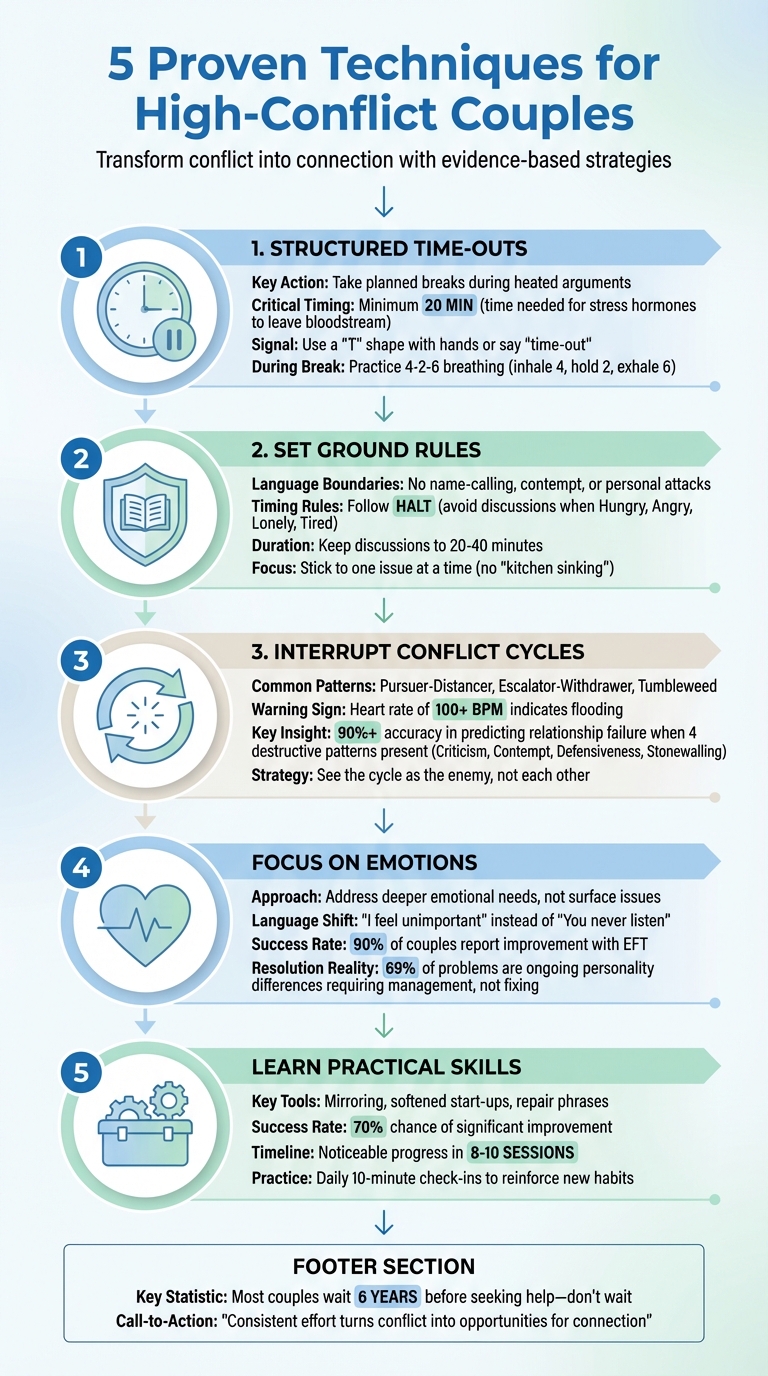
5 Proven Techniques to Manage High-Conflict Relationships
Identifying High-Conflict Couples and How to improve communication
1. Structured Time-Outs and Self-Soothing
When arguments heat up, your body can shift into survival mode – your heart races, stress levels spike, and clear thinking takes a backseat. This is your brain kicking into fight, flight, freeze, or fawn responses [11]. In this state, truly listening to your partner or resolving conflict becomes nearly impossible. That’s where structured time-outs come in.
A time-out isn’t about storming off or giving the silent treatment. It’s a planned break, agreed upon in advance, designed to let your nervous system reset. Research shows it takes at least 20 minutes for stress hormones like norepinephrine to leave your bloodstream [11]. Dr. John Gottman explains:
"The major sympathetic neurotransmitter norepinephrine doesn’t have an enzyme to degrade it so it has to be diffused through blood… this takes twenty minutes or more in the cardiovascular system." [11]
To make time-outs effective, agree on a neutral signal beforehand – something simple like making a "T" shape with your hands or calmly saying "time-out" [9][10]. When either partner uses the signal, both step away for at least 20 minutes, but no longer than 24 hours [11]. During this break, avoid replaying the argument in your mind. Instead, focus on calming your body. Try the 4-2-6 breathing method: inhale for 4 counts, hold for 2, and exhale for 6 [3]. Splashing cold water on your face can also help reset your system [11].
This approach is especially helpful for couples dealing with addiction recovery, where intense stress can trigger a relapse [12]. Taking a step back prevents impulsive reactions and allows you to return to the discussion as allies, not opponents. Whoever initiates the time-out is responsible for reconnecting once they’ve calmed down [12]. This intentional pause creates the foundation for meaningful repair and resolution.
For expert guidance on couples counseling and relationship repair, visit Growth and Change Counseling at https://johnmarkkane.com.
2. Clear Conflict Ground Rules and Communication Boundaries
Arguments can easily spiral out of control without some agreed-upon ground rules. Setting clear boundaries around language, timing, and topics creates a framework to keep things productive and respectful, even during emotional moments. These boundaries act as a safeguard for your relationship when tensions run high.
Start by addressing language boundaries. Agree to avoid name-calling, contempt, or personal attacks. Instead of blaming, focus on making objective observations. For example, say, "I see the kitchen isn’t clean, and I’m feeling overwhelmed," rather than pointing fingers. This shift from blame to vulnerability can change the tone of the conversation entirely. As Ellie Lisitsa, PhD, wisely says:
"Love is saying ‘I feel differently’ instead of ‘you’re wrong’." [14]
Timing also plays a critical role in managing conflict. Following the HALT rule – avoiding serious discussions when either partner is hungry, angry, lonely, or tired – can prevent unnecessary escalation. [15] Before diving into a tough conversation, ask, "When would be a good time to talk about this?" [13] Keeping discussions brief, ideally between 20–40 minutes, helps avoid emotional burnout and keeps things focused. [13]
Another key boundary is sticking to one issue at a time. Resist the urge to "kitchen sink" – bringing up every past grievance in a single conversation. This approach can overwhelm both partners and derail any progress. Instead, if new issues come up, make a note to address them later. Staying focused on one topic makes conflicts more manageable and resolutions more achievable.
By establishing these boundaries, you create a foundation for respectful and productive conflict management. As Dr. K, a licensed psychologist, puts it:
"Conflict itself isn’t the problem – it’s how we handle it that matters." [13]
If setting these boundaries feels overwhelming, seeking professional help can be a game-changer. Couples counseling, such as the services offered by Growth and Change Counseling, can provide the tools and guidance needed to navigate these challenges effectively.
3. Recognizing and Interrupting the Conflict Cycle
For many high-conflict couples, the real issue isn’t the specific argument at hand – it’s the repetitive emotional loop they find themselves trapped in. Marina Rosenthal, a licensed therapist, puts it this way:
"The particular words said are not really the point. The point is the messy, hurtful, cycle you keep getting stuck in." [2]
The first step to breaking free is identifying your unique conflict pattern. Some common ones include:
- Pursuer-Distancer: One partner pushes for immediate resolution while the other pulls away.
- Escalator-Withdrawer: One partner raises their voice while the other goes silent.
- Tumbleweed: Old wounds and unrelated grievances keep resurfacing. [2][16]
Dr. John Gottman’s research highlights four destructive communication patterns – Criticism, Contempt, Defensiveness, and Stonewalling – that predict relationship failure with over 90% accuracy. Among these, contempt stands out as the strongest predictor of a relationship’s collapse [16].
It’s also crucial to tune into your body during conflict. A heart rate of 100 beats per minute or higher often indicates physiological flooding, where your reactive brain takes over and reason flies out the window. Other physical signs, like a clenched jaw, muscle tension, or feeling overheated, are red flags to watch for [11]. These signals are your cue to pause and recalibrate.
Once you’ve identified the cycle, step in to interrupt it using a pre-agreed timeout strategy [11]. The goal isn’t to determine who’s right but to work together to break the pattern. Tiara Lipps from Stanford Couples Counseling captures this perfectly:
"Once both partners see the cycle as the enemy (instead of each other), they can begin to interrupt it." [1]
sbb-itb-596b85d
4. Emotion-Focused and Attachment-Based Repair
High-conflict arguments often stem from deep fears and unmet emotional needs. For instance, when one partner becomes critical or seeks connection, it can be a way of protesting emotional abandonment. On the other hand, the other partner might withdraw to shield themselves from feelings of inadequacy. Emotionally Focused Therapy (EFT) tackles these hidden insecurities by reframing conflict as a signal of unmet emotional needs, rather than just surface-level disagreements.
EFT emphasizes that anger and blame often mask deeper, more vulnerable emotions like fear, sadness, or loneliness. As Ian Witter, LMFT, puts it:
"EFT helps to drive connection through emotional vulnerability as opposed to emotional reactivity." [18]
One key approach in EFT is replacing blame-filled statements with expressions of vulnerability. For example, instead of saying, "You never listen", try, "I feel unimportant to you." This subtle shift can create an atmosphere of connection and reduce defensiveness.
The effectiveness of EFT is backed by research: 90% of couples report improvement, and 70–75% no longer experience significant relationship distress after using this approach. [17]
When anger flares up, consider asking yourself, "What am I afraid of?" For recurring issues, try exploring the core emotional need behind your stance. It’s important to note that about 69% of relationship problems are ongoing and may not have a clear resolution – they require understanding rather than fixing. [6]
By recognizing that the negative cycle of interaction – not your partner – is the real issue, couples can begin to rebuild trust and secure their emotional bond.
If you want expert support to deepen emotional connection and apply these techniques, check out the couples counseling services offered by Growth and Change Counseling.
5. Directive, Skills-Based Coaching for Repair and Reconnection
While earlier methods focus on calming tensions, directive coaching takes a more hands-on approach by equipping couples with practical tools for immediate repair. When relationships are in crisis, waiting years for improvement isn’t an option. Directive coaching delivers actionable skills right away, giving partners techniques they can use immediately. Unlike traditional counseling methods that often rely on open-ended discussions, this approach provides a clear framework to prevent heated conversations from escalating further.
This style of coaching also actively guides couples during moments of conflict. Dr. Ellyn Bader, Co-Founder of The Couples Institute, emphasizes this point:
"Slowing down in here and letting me coach you will enable you to learn new skills." [5]
For example, instead of saying, "You never help", a partner might express, "I feel unappreciated when the kitchen isn’t cleaned; could you help me tonight?" This subtle shift transforms blame into vulnerability, fostering collaboration instead of defensiveness.
Directive coaching introduces tools like mirroring (repeating back what your partner says to ensure understanding), softened start-ups (addressing issues without triggering defensiveness), and structured repair phrases such as "I feel scared" or "Please say that more gently." These techniques are practiced during sessions and reinforced at home with specific assignments – like 10-minute daily check-ins – that encourage accountability and help solidify new habits. This skill-driven approach aligns seamlessly with earlier conflict de-escalation strategies.
Statistics reveal the impact: couples who adopt these skills have a 70% chance of significantly improving their relationship [12]. Evidence-based coaching often yields noticeable progress after just 8–10 sessions of consistent effort [8]. Considering that most couples wait an average of six years before seeking professional help [7], directive coaching shortens this timeline by prioritizing quick skill-building over prolonged exploration.
For couples in urgent need of focused, structured help, Growth and Change Counseling offers The Marriage Rescue Institute. This 12-week program is designed to provide partners with practical tools to rebuild and strengthen their relationships.
Moving Forward with Growth and Change Counseling
High-conflict couples don’t need to resolve every disagreement; instead, they need to approach conflict in a new way. The five techniques discussed here work as a cohesive system: structured time-outs help soothe the nervous system and bring clarity, ground rules create a safe space for tough conversations, recognizing the conflict cycle shifts focus away from blame, emotion-focused repair heals past wounds, and directive coaching equips couples with practical skills they can use right away. Together, these strategies can turn conflicts into opportunities for deeper connection.
But practice is key. As Ellie Lisitsa, PhD, emphasizes:
"No one learns these skills overnight. It takes practice, and sometimes you need to build up to having effective communication in your partnership" [14].
Research reveals that 69% of relationship problems stem from personality differences and are essentially unsolvable [6]. This means the goal isn’t to "fix" everything but to manage these issues over time. Consistent effort leads to noticeable improvements.
Rebuilding trust also involves addressing emotional imbalances through regular repair attempts – whether that’s an apology, humor, or a simple gesture like physical touch. Dr. Galit Birk offers a powerful reminder:
"The things that we sweep under the rug don’t really go away; when we lift the rug they are still there, only dirtier and bigger than before" [4].
For couples facing more severe challenges, everyday strategies might not be enough. In such cases, more intensive support becomes crucial. Programs like Growth and Change Counseling’s Marriage Rescue Institute provide a structured, 12-week intensive designed to help couples in crisis. This approach focuses on breaking toxic patterns and introducing healthier communication habits in a hands-on, real-time setting.
With the right strategies and a commitment to consistent effort, even couples facing the toughest challenges can rebuild trust and create a more secure, connected relationship.
FAQs
What’s the difference between taking a structured time-out and giving the silent treatment?
A structured time-out is a deliberate and mutually agreed-upon pause in a conversation. Its goal? To give both partners a chance to cool off and return to the discussion with a clearer, calmer mindset. This technique comes with a set purpose, a specific time frame, and a shared commitment to revisit the issue afterward. Couples are encouraged to practice this in advance, learning to recognize when emotions are running high and stepping away momentarily to reset.
On the other hand, the silent treatment is an unplanned, often punitive withdrawal from communication. One partner shuts down, offering no indication of when – or if – they plan to address the issue again. This approach can leave the other person feeling rejected and resentful, as it halts dialogue and erodes trust. While time-outs are a cooperative way to ease tension and work toward resolution, the silent treatment creates emotional distance and blocks progress.
What are some effective communication techniques for couples in high-conflict relationships?
Improving communication in high-conflict relationships often begins with practicing a few key skills that can ease tension and build stronger connections:
- Start conversations gently by using a calm and non-accusatory tone. For instance, saying “I feel upset when…” is far more effective than “You always…” as it encourages a more cooperative atmosphere.
- Practice active listening by reflecting back what your partner shares before responding. Pair this with “I” statements, like “I feel overwhelmed when…,” to express your emotions without assigning blame.
- Use repair attempts during heated discussions. Simple gestures like saying, “I’m sorry I got upset,” or suggesting a brief pause to cool off can go a long way in keeping the dialogue productive.
These approaches, among others, are a central part of the 12-week couples coaching program offered by Growth and Change Counseling through The Marriage Rescue Institute. The program is designed to help couples rebuild healthier communication patterns and strengthen their relationships.
How does understanding conflict patterns help couples reduce tension?
Recognizing repeated conflict patterns can help couples shift the focus from blaming each other to understanding the dynamics at play. For instance, identifying a cycle like a trigger-response-escalation loop allows partners to step back, interrupt the cycle, and respond in a calmer, more intentional way.
By digging deeper into the emotions fueling these conflicts – such as fear, feeling dismissed, or perceiving criticism – couples can move beyond surface-level arguments and address the real underlying issues. Simple practices like taking a moment to pause, using deep breathing, or finding ways to self-soothe can help defuse emotional intensity. This kind of self-awareness not only reduces misunderstandings but also creates space for healthier and more productive communication.
Related Blog Posts
- Co-Regulation Techniques for Couples
- How to Solve Recurring Arguments in Marriage
- Q&A: Managing Anger and Communication in Marriage
- Couples Therapy for Trauma Recovery
