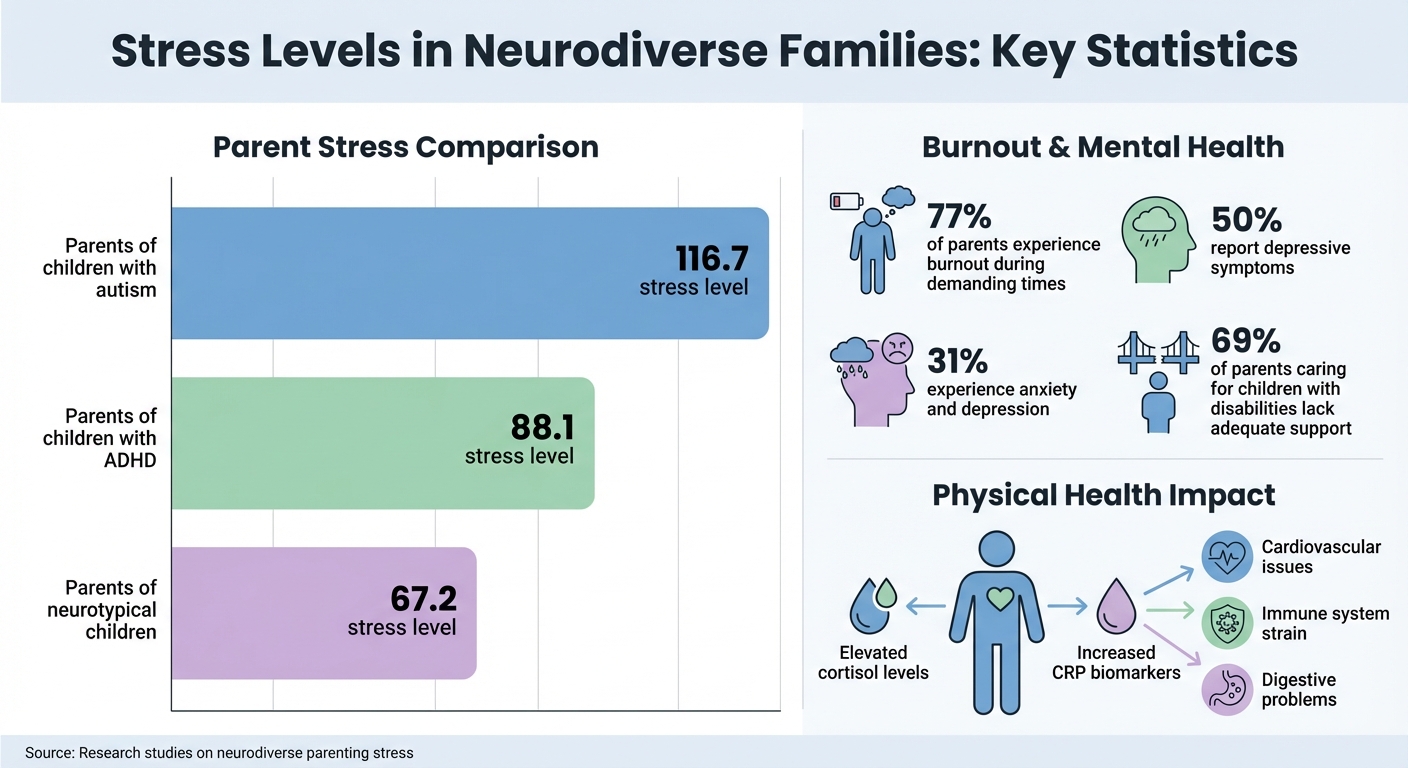
Parenting a neurodivergent child can be overwhelming, with stress levels higher than those of parents raising neurotypical children. Common struggles include managing emotional outbursts, 24/7 caregiving, and financial pressures from therapies and support services. Research shows that up to 77% of parents in these situations experience burnout, and nearly 50% report depressive symptoms.
To reduce stress, focus on practical strategies:
- Low-demand parenting: Prioritize key behaviors, offer choices, and use simple instructions to avoid power struggles.
- Consistent routines: Use visual schedules and maintain predictable daily patterns to create stability.
- Manage sensory overload: Identify triggers and use tools like noise-canceling headphones or calming spaces.
- Seek support: Build a network of family, community groups, and professionals to share caregiving responsibilities.
Childhood Neurodivergence: Managing Parental/Carer Stress
Common Sources of Stress for Neurodiverse Parents
Parenting Stress Statistics for Neurodiverse Families
Parenting is no easy feat, and for neurodiverse parents raising neurodivergent children, the challenges can feel especially overwhelming. While every family’s journey is unique, research highlights several recurring stressors that contribute to burnout.
Managing Emotional and Behavioral Difficulties
Caring for a neurodivergent child often means navigating daily hurdles like meltdowns, emotional outbursts, impulsivity, and noncompliance. These situations require constant vigilance to identify triggers and address sensory sensitivities [6][1].
Studies reveal that parents of children with autism or ADHD experience significantly higher stress levels – 116.7 and 88.1, respectively – compared to 67.2 for parents of neurotypical children [7]. What makes this even tougher is that conventional parenting strategies, such as "Time Out", often backfire with neurodivergent kids, leaving parents feeling ineffective and unsure of what to do [2].
"Parents of neurodivergent children commonly report that when they share with other parents that things are difficult, the response is often, ‘Yes, my child also screams and has meltdowns.’ This is a well-intended but confusing response, leaving many parents… wondering why it is so hard for them to cope." – Odelya Gertel Kraybill Ph.D., Psychology Today [4]
This constant state of being "on" takes a toll on the body. Research shows that parents of children with autism have elevated cortisol levels and increased biomarkers like CRP, which are linked to health concerns such as cardiovascular issues, immune system strain, and digestive problems [6].
The unrelenting demands of managing behavior often set the stage for deeper exhaustion tied to round-the-clock caregiving.
Constant Caregiving Without Breaks
When caregiving becomes a 24/7 responsibility, burnout can creep in. This form of burnout is marked by intense exhaustion, a loss of joy in parenting, and emotional withdrawal as a way to cope [2].
"Parental burnout is not a fleeting frustration or the reaction to a tough parenting day. Burnout represents a chronic experience of overwhelm resulting from an imbalance between parenting demands and the resources available to meet those demands." – Corrie Goldberg, Ph.D., Licensed Clinical Psychologist [2]
The numbers are staggering: 69% of parents caring for children with disabilities say they lack adequate support [3]. During particularly demanding times, burnout rates among parents of children with ADHD or anxiety can soar to 77% [2]. This exhaustion makes it harder for parents to regulate their own emotions, which is critical for providing the co-regulation neurodivergent children rely on to feel secure [1].
For neurodivergent parents raising neurodivergent children, these challenges can multiply. For instance, an autistic parent with sensory sensitivities might find it draining to meet a child’s need for loud play or constant physical touch, leading to feelings of being "touched out" or an urge to retreat [2].
And while emotional fatigue is a major factor, logistical and financial pressures only add to the load.
Financial and Scheduling Pressures
The costs of raising a neurodivergent child can be staggering. Families often face high expenses for therapies like ABA, speech therapy, occupational therapy, specialized medical care, and adaptive equipment [6][3]. These financial pressures are compounded when parents have to cut back on work hours or deal with job instability due to caregiving responsibilities [6].
On top of financial strain, there’s the relentless task of managing schedules. Parents juggle therapy appointments, medical visits, and school meetings – like IEP or 504 plan evaluations – all while handling insurance claims and administrative paperwork [1][2][8]. For parents with executive functioning challenges, such as those with ADHD, this can feel nearly impossible to manage [2].
This mismatch between a parent’s personal capacity and the constant demands of caregiving can push families into survival mode, leaving little room for balance or relief.
Understanding these stressors is a critical step toward finding ways to reduce the burden and support neurodiverse families.
Solutions to Reduce Parenting Stress
Parenting can be challenging, especially when navigating the unique needs of neurodivergent children. But small, intentional changes in your daily approach can ease stress for both you and your child. Let’s explore some practical strategies.
Using a Low-Demand Parenting Approach
Traditional discipline methods often escalate tension with neurodivergent children, leading to more meltdowns. A low-demand approach focuses on reducing these power struggles by prioritizing behaviors and offering simple, manageable choices.
"The reptilian part of their brain is unusually sensitive and reactive. Once triggered, it persists in staying in control of brain functions longer than it should… Worried parents respond by turning up the intensity of their cajolery and discipline; children react further and become even more out of control." – Odelya Gertel Kraybill, Ph.D., Psychology Today
Here’s how this approach works:
- Behavior triage: Focus on the most pressing issues and let smaller ones slide when possible.
- Offer choices: For example, ask, "Would you like to start with math or writing?"
- Use "When-Then" instructions: These provide clear expectations, like "When you finish your snack, then we’ll play outside."
- Acknowledge emotions: Statements like "I see you’re feeling frustrated" can help defuse situations.
- Break tasks into steps: Instead of saying, "Stop running", try, "Please walk." If needed, allow a short pause before repeating instructions.
Staying calm yourself is key. By co-regulating – helping your child recognize stress while managing your own – you can create a more peaceful environment.
Creating Consistent Daily Routines
Predictability is a game-changer. For neurodivergent children, knowing what comes next can significantly reduce stress and make transitions smoother.
"Routines and other forms of daily structure ground your child, reduce stress, and help with organization." – Caroline Mendel, PsyD, Clinical Psychologist
Here are some tips to build effective routines:
- Use visual schedules, timers, or checklists to outline the day’s activities.
- Balance structured activities with unstructured time for rest or play.
- Keep sleep schedules, meal times, and physical activity consistent.
By creating a rhythm to the day, you can help your child feel more secure and reduce the unpredictability that often leads to burnout.
Managing Sensory Sensitivities
Sensory overload can derail even the best intentions. Recognizing triggers and having tools ready can prevent escalation for both you and your child.
For children, tools like weighted blankets, compression clothing, and calm spaces can make a big difference. Visual timers and giving short transition warnings can also help ease stressful moments.
For parents, managing your own sensory overload is equally important. Strategies like wearing noise-canceling headphones, engaging in repetitive calming activities, or simply reminding yourself, "It’s okay to feel this way", can help you stay grounded.
"As a general rule, remind yourself that you are always doing the best that you can at any given moment." – Odelya Gertel Kraybill, Ph.D., Expressive Trauma Integration
sbb-itb-596b85d
Building Your Support Network
Caregiving is not something you can handle alone. Without a solid support system, the stress can quickly pile up, taking a serious toll on your physical and emotional health. Research highlights that prolonged stress can weaken your immune system and even speed up cellular aging [12].
Creating a support network isn’t just helpful – it’s essential. Balancing family involvement, community connections, and professional help can shift you from merely getting by to achieving a healthier, more sustainable way of living.
Getting Help from Family and Community
Start by identifying your core circle – family members and close friends who can step in with practical, regular help. When reaching out, be specific. Instead of saying, "Let me know if you need anything", try something more direct, like, "Can you pick up my child from therapy on Tuesdays?" or "Would you be able to bring dinner once a week?"
Connecting with other parents who understand your experiences can also make a huge difference. Seek out your local Special Education PTA (SEPTA) or join neurodiversity-affirming support groups in your area [3] [9]. These relationships can help combat the loneliness that caregiving often brings.
"We need community because we can’t do this alone. We need reinforcement from other parents." – Sara deLeon, Licensed Psychologist at Hope Comprehensive Center for Development [11]
One parent shared how joining a support group not only reduced their stress but also allowed them to share caregiving responsibilities with others who truly understood their challenges.
If you’re looking for more tailored advice, professional counseling and coaching can provide strategies that address your unique situation.
Working with Professional Counselors and Coaches
Professional support can be a game-changer for both parenting challenges and emotional well-being. Parent coaching focuses on practical, actionable solutions – like managing meltdowns, navigating Individualized Education Programs (IEPs), and creating effective daily routines [13] [14]. Therapy, on the other hand, helps you work through the complex emotions that often accompany raising a neurodivergent child, such as grief or guilt [5] [4].
Mindfulness-based stress reduction has been shown to ease anxiety, improve sleep, and reduce symptoms of depression [12]. Growth and Change Counseling offers parent coaching and therapy, both in-person (in locations like Campbell, San Jose, Los Angeles, and Roseville) and through telehealth across California, making it easier to find support that fits your schedule.
Taking Advantage of Respite Care
Respite care is more than just a break – it’s a lifeline. Scheduled time off helps reduce stress and prevents burnout, ensuring you can continue to care for your child effectively. Research shows that respite care not only lowers parental distress but can also strengthen relationships, giving couples time to reconnect and focus on each other [12].
You can explore respite services through local programs or the National Respite Care Network [5].
"Raising a child with a disability is a marathon. If we as caregivers don’t practice self-care, it’s very difficult to do what we do for our children." – Maria Daane, Executive Director of Parents Helping Parents [10]
How Growth and Change Counseling Can Help

Growth and Change Counseling provides tailored support for neurodiverse families, offering a lifeline for parents navigating the unique challenges of raising a neurodivergent child. Instead of focusing on "fixing" differences, their approach emphasizes understanding and celebrating natural variations in cognitive functioning. Using a trauma-informed, strengths-based model, the practice embraces neurodiversity as a natural part of human experience rather than a deficit [16].
Parent Coaching for Personalized Support
Parent coaching at Growth and Change Counseling delivers customized strategies to address the specific needs of your family. With evidence-based methods like PCIT, PMT, and CBT, coaches guide parents in managing emotional and behavioral challenges, securing IEPs and 504 Plans, and advocating effectively for their children. They also work with families to identify triggers, aiming to ease the overwhelming feeling of "walking on eggshells" [13][14][15]. These practical tools not only help with daily struggles but also contribute to reducing parenting stress.
"Our collaborative approach empowers parents to better understand their children and themselves, creating a foundation for growth and connection." – Child Psychology Center [13]
In-Person and Telehealth Services
Families can access Growth and Change Counseling’s services in person at locations in Campbell, San Jose, Los Angeles, and Roseville, or through telehealth across California. Parent coaching sessions are available at $150 for a 45-minute session with an Associate MFT or $200 for the same session with a Licensed MFT. Sliding scale options are also offered to ensure accessibility [13].
Conclusion
Parenting a neurodivergent child often feels overwhelming and isolating. Studies reveal that 31% of parents in this situation experience anxiety and depression, while half show depressive symptoms [3]. These numbers highlight the emotional strain that comes with managing meltdowns, navigating complicated systems, and dealing with financial pressures. It’s clear that finding ways to restore balance is essential.
One approach that can help is low-demand parenting, which eases the pressure on both you and your child. Pairing this with consistent daily routines can create a sense of predictability, helping neurodivergent children feel more secure and reducing the likelihood of meltdowns. Additionally, building a strong support network – whether through family, community connections, respite care, or professional guidance – can provide the resources you need to handle daily challenges more effectively.
Your emotional health plays a key role in your child’s ability to manage their emotions. As Professor Nim Tottenham from Columbia University emphasizes, "Do what you can to take care of your well-being, to make sure you are feeling safe, and to manage your own emotions in a healthy way. When you feel this way, that gets translated to your children in a powerful way" [17]. Prioritizing self-care isn’t selfish – it’s necessary. By combining self-care with structured support, you can turn daily challenges into manageable routines.
Whether you’re practicing self-care at home, connecting with other parents who share similar experiences, or seeking guidance from professionals who specialize in neurodiverse families, every step you take to reduce stress strengthens your family. Growth and Change Counseling offers parent coaching and therapy tailored to families like yours, with both in-person and telehealth options throughout California. This comprehensive support can help you build a solid foundation for your family’s well-being.
Your journey is demanding, but the effort you put into supporting your own well-being is one of the most impactful things you can do for yourself and your child.
Finding Your Path Forward with Growth and Change Counseling
What is low-demand parenting, and how does it benefit neurodivergent children?
Low-demand parenting is a style that focuses on easing the pressure placed on a child by reducing the number and intensity of expectations. This approach is particularly helpful for children who experience high levels of anxiety or stress, including those on the autism spectrum or with Pathological Demand Avoidance (PDA). However, it’s not limited to these groups – it can benefit any neurodivergent child who feels overwhelmed by rigid rules or constant demands. The core principles of this method are trust, adaptability, and collaboration, where the child takes the lead, and parents adjust the environment to support their sensory and emotional needs.
By scaling back on demands, parents can help their child avoid triggering a "fight-or-flight" response, creating a calmer atmosphere where the child can work on self-regulation and coping strategies. This shift often results in fewer conflicts, reduced meltdowns, and a stronger sense of security for the child. For parents, it can also relieve stress by moving the focus from enforcing strict rules to fostering a nurturing and understanding relationship.
Growth and Change Counseling provides services like parent coaching, family therapy, and personalized guidance to help families incorporate low-demand parenting techniques in a way that suits their specific circumstances.
What are some effective ways for parents to manage sensory overload in neurodivergent children?
Sensory overload occurs when a child’s brain becomes overwhelmed by too much sensory input – things like loud noises, bright lights, or certain textures. This can lead to feelings of anxiety, agitation, or even complete shutdowns. To help your child navigate these challenges, it’s important to first pinpoint their specific triggers and plan accordingly. For instance, you can preview new environments together, use visual schedules, and talk through what they can expect to minimize surprises.
Having a sensory-friendly kit on hand can also be a game-changer. Items like noise-canceling headphones, a weighted lap pad, or a favorite soft blanket can provide much-needed comfort when things get overwhelming. At home, consider creating a quiet retreat – a space with dim lighting and cozy seating where your child can decompress. Short sensory breaks, like deep-pressure hugs or a quick round of jumping jacks, can also help regulate their nervous system when they’re feeling overstimulated.
Equipping your child with simple self-regulation tools, such as teaching them to say, "I need a break", empowers them to take charge of their needs. For families seeking more tailored support, Growth and Change Counseling offers parent coaching and family therapy. These services can help create personalized sensory-management strategies, improving your child’s day-to-day experience and fostering a more peaceful family dynamic.
How can parents of neurodiverse children build a supportive caregiving network?
Building a reliable support network is crucial for parents of neurodiverse children. It offers emotional backing, practical guidance, and those much-needed moments to recharge – making the caregiving journey more manageable. A strong network can ease feelings of isolation, enhance your ability to advocate for your child, and improve your overall well-being.
Start by exploring local or online groups centered on neurodiversity. These spaces connect you with people who truly understand your experiences. Think about what you need most – whether it’s emotional encouragement, advice, or logistical help – and seek resources that meet those needs. Professional services, like parent coaching or family therapy, can also play a big role. For families in California, Growth and Change Counseling provides specialized support for neurodiverse households, offering both in-person and telehealth options.
Don’t overlook community resources, either. Tap into school-based special education staff, advocacy groups, or respite care programs. By blending peer connections, expert guidance, and local services, you can create a support system that reduces stress and nurtures a healthier, more balanced family life.
Related Blog Posts
- 5 Ways to Support Your Neurodiverse Partner
- Parenting Through Marital Conflict and Mental Health Struggles
- Ultimate Guide to Routines for Neurodiverse Families
- Trauma and Advocacy: Supporting Neurodiverse Families
