Attachment wounds, often rooted in childhood, can create patterns of anxiety or avoidance in relationships, especially in marriage. These patterns may lead to misunderstandings, emotional distance, or conflict. The good news? Healing is possible through intentional actions, open communication, and, when needed, professional support. Here’s a quick summary of the five steps to address and repair attachment wounds in your marriage:
- Identify and Accept the Wound: Understand your attachment style (secure, anxious, avoidant, or disorganized) and how it influences your behavior. Use "I" statements to discuss past experiences with your spouse without assigning blame.
- Commit to Healing Together: Make a joint effort to address emotional wounds. Set clear goals, create safe emotional spaces, and establish habits like regular check-ins or conflict repair rules.
- Communicate with Vulnerability: Use frameworks like "I Feel, I Need, I Request" to express emotions constructively. Validate your partner’s feelings and focus on specific, actionable needs.
- Build New Patterns of Security: Replace harmful habits with consistent, reliable actions that promote trust. Implement rituals like daily check-ins or weekly date nights to strengthen your bond.
- Seek Professional Help: Work with a therapist trained in attachment theory or relational trauma to gain tools and guidance for deeper healing. Programs like the Marriage Rescue Institute offer structured support.
Healing Attachment Wounds: Guidance from Growth and Change Counseling
Step 1: Identify and Accept the Wound
The journey to healing begins with recognizing attachment wounds and understanding how they shape your marriage. These wounds aren’t flaws in your character; they’re emotional patterns rooted in past experiences. They influence how you handle intimacy, conflict, and connection today. The key here isn’t about assigning blame to yourself or your spouse – it’s about becoming aware of behaviors tied to past pain rather than your current reality. A great starting point is identifying your attachment style to better understand these patterns.
Understanding Your Attachment Style
Attachment styles – secure, anxious, avoidant, and disorganized – play a significant role in how relationships unfold. Each style comes with its own set of tendencies:
- Secure attachment (56% of people): Promotes a healthy balance between closeness and independence. Those with this style trust that love remains steady, even during conflicts.
- Anxious attachment (19%): Often stems from a fear of abandonment, leading to behaviors like overanalyzing response times or seeking constant reassurance.
- Avoidant attachment (25%): Drives individuals to keep emotional distance and lean on self-reliance, especially when intimacy feels overwhelming.
- Disorganized attachment: A mix of anxious and avoidant tendencies, creating unpredictable and emotionally intense interactions.
"This early bond creates a template or rules for how you build and interpret relationships as an adult."
– John Bowlby, Psychiatrist and Psychoanalyst
Understanding your attachment style can shed light on recurring behaviors, like shutting down during arguments or constantly checking for emotional availability from your spouse. These behaviors often trace back to earlier attachment wounds. If you’re unsure about your style, an attachment quiz can help clarify things. Keep in mind that attachment exists on a spectrum – you might not fit perfectly into one category, and your style can shift depending on circumstances or even the partner you’re with. Once you’ve gained clarity, it’s time to share your insights with your spouse.
Talking Openly About Your Past
After pinpointing your attachment style, the next step is having an open conversation with your spouse. The goal is to foster understanding, not defensiveness. Start by separating past experiences from your present relationship. Ask yourself, "Who was the first person to make me feel this way?" This helps you realize your partner isn’t the source of old pain. For instance, if you had an emotionally unavailable parent, you might misinterpret your spouse’s need for alone time as rejection, even when it’s not intended that way.
"It’s important to put a name to the person who hurt you, and recognize that it’s not the same name as the person you are in a relationship with right now."
– Morgan Hancock, Therapist
When discussing your feelings, use "I" statements to express yourself without placing blame. For example, instead of saying, "You never listen to me", try, "I feel unheard when you multitask during our conversations, and I feel loved when you focus solely on me." This approach creates a safe emotional environment and minimizes defensiveness. Acknowledging your pain without pointing fingers allows both of you to better understand each other and begin the healing process together. This step lays the groundwork for mutual growth and connection in your marriage.
Step 2: Commit to Healing Together
Once you’ve gained insight into your attachment wounds in Step 1, it’s time to take the next step: healing together. This is where the real work begins. Addressing attachment wounds requires a joint effort – it’s not something you can fix on your own. Healing happens in the context of safe, supportive connections with your spouse. Without mutual effort and open communication, building a secure bond in your marriage becomes incredibly challenging [3].
Making a Joint Commitment
Commitment isn’t just about making promises; it’s about showing up and working through the tough moments together. Start by having an open and honest conversation about what you’re both willing to do. Ask yourselves: Are we ready to share difficult feelings without shutting down? Can we listen to each other’s pain without becoming defensive? This kind of vulnerability is key to breaking the anxious-avoidant cycle and creating a healthier, more collaborative relationship [3].
Set specific, actionable goals as a team. For instance, you might agree to use the "I Feel, I Need, I Request" approach during tense moments. Instead of saying, "You never make time for me", you could try: "I feel anxious when our plans change last minute. I need to feel prioritized. I request a text if you’re going to be more than 10 minutes late" [4][7]. Another idea is to adopt the 24-hour repair rule – agreeing to reconnect within 24 hours after a conflict to address the issue and decide on next steps. These small, intentional agreements create a structure for accountability and progress.
From there, focus on building an environment that fosters trust and emotional safety.
Building a Safe Emotional Space
Rebuilding trust takes time and consistency. It starts with small, reliable actions that signal to your nervous system that your relationship is dependable [4]. This could mean keeping promises, responding to texts promptly, or simply being present when your partner needs you.
Incorporate daily rituals that help rebuild trust and soothe old attachment wounds. For example, you might set aside 20 minutes after work to decompress together or commit to a weekly date night that’s non-negotiable. These predictable habits create a sense of safety and help disrupt old patterns of fear or avoidance. When conflicts arise, try implementing the 10-minute pause rule: if emotions run high, take a break and revisit the conversation once you’ve both had time to cool off [4].
Another helpful tool is reflective listening. When your spouse shares a concern or need, repeat back what you heard before responding. For example, you might say, "So you’re feeling unheard and want more focused attention during our conversations – did I get that right?" This practice ensures clarity and shows your partner that their feelings are important. The goal isn’t to be flawless – it’s about being consistent. Each time you stay present, validate each other’s emotions, and follow through on your commitments, you’re working together to reshape old attachment patterns and build a stronger connection.
Step 3: Communicate with Vulnerability
Opening up about your feelings and struggles is key to building a deeper connection. Vulnerability isn’t about showing weakness – it’s about creating a space where your partner can truly understand your emotions. When you share honestly, without blame or defensiveness, you pave the way for healing and mutual understanding.
Sharing Pain Without Blame
When you’re hurt, it’s tempting to say things like, "You never listen to me" or "You don’t care about my feelings." But statements like these often lead to defensiveness rather than connection. Instead, try using the "I Feel, I Need, I Request" framework to express your emotions constructively [4]. Here’s an example:
"I feel anxious when I don’t hear back from you for hours. I need to feel reassured that our connection matters. I request a quick thumbs-up text if you’re tied up."
This method separates your feelings from judgment, making it easier for your partner to understand and respond without feeling attacked.
Before diving into tough conversations, calming yourself can make a big difference. Techniques like the 4-7-8 breathing method – inhaling for four counts, holding for seven, and exhaling for eight – can help ease stress. Another option is the "Name it to Tame it" strategy, where you simply label your emotions (e.g., "I’m feeling overwhelmed right now"). This can help you shift from a reactive state to a more thoughtful one.
For instance, instead of saying, "You always put work ahead of us", you could say, "I feel lonely when you work late. I need us to spend more time together." Using the "I Feel, I Need, I Request" framework keeps the conversation focused and productive.
Validating Feelings and Apologizing
Once you’ve shared your feelings, it’s equally important to validate your partner’s emotions when they open up to you. Your job isn’t to fix their pain or explain your actions – it’s to listen and acknowledge what they’re feeling. Reflective listening can help. For example, after your partner shares, you might say, "So you’re feeling lonely and asking for more quality time together – did I understand that correctly?"
"We do not need our spouses to stop hurting us; what we need is adequate repair." – Adam Young, Therapist [11]
When it comes to apologizing, avoid adding a "but" to your apology. Saying, "I’m sorry, but you overreacted" can make things worse. Instead, focus on owning your part: "I’m sorry for what I did; I see how it hurt you." Studies show that even acknowledging a small part of your partner’s perspective can go a long way in repairing emotional wounds.
Expressing What You Need Now
After addressing past pain, it’s important to clarify what you need moving forward. Vague requests like "I need you to care more" can leave your partner unsure of how to act. Be specific. For example, you might say, "I’d like us to set aside one evening a week to spend time together."
"When spouses can clearly state what they need from their partner without blame or criticism, and especially by using ‘I’ statements, they help their partner see where they can focus their efforts to reconnect successfully." – Jon Beaty, Licensed Clinical Social Worker [10]
Focus on what you want rather than what you don’t want. For instance, instead of saying, "You’re always on your phone", try, "I’d love 20 minutes of uninterrupted conversation after dinner." This provides a clear, actionable goal and encourages teamwork. After a heartfelt conversation, take a moment to express gratitude, such as saying, "Thank you for hearing me out." These small gestures can strengthen trust and deepen your connection.
sbb-itb-596b85d
Step 4: Build New Patterns of Security
After opening up about your emotions, the next step is to replace old, damaging habits with new ones that foster trust. Negative patterns won’t disappear on their own – they stick around until you actively work to change them. By building on the vulnerability you developed in Step 3, you can create practices that strengthen the foundation of your relationship.
Interrupting Destructive Patterns
The first step toward change is recognizing when you’re falling into familiar, harmful cycles. Take time to map out your typical conflict patterns. How do your arguments usually start? What tends to escalate them? How do both of you react? For instance, does one partner retreat while the other pursues? Does criticism spark defensiveness, creating a back-and-forth of negativity? Identifying these patterns is key [9].
Keeping a trigger log can help you spot and stop these cycles early. This tool helps you pinpoint emotional triggers and take action before things spiral [4]. Research shows that after a six-week mindfulness program, people with attachment anxiety experienced fewer negative emotions and a boost in positive mood on a daily basis [4].
When conflict feels overwhelming or emotions run high, it’s okay to take a pause. Agree to revisit the conversation when you’re both calmer. Phrases like, “I’m feeling overwhelmed right now,” or asking yourself, “What part of me is showing up here?” can help you ground yourself and shift out of autopilot [4].
"Attachment wounds form in relationships, but they can also heal in relationships, including the one you build with your own inner world."
- Lillian "Nikki" Hurley-Hines, MA, LPC, LMHC [12]
Once you’ve learned to pause and recognize these destructive patterns, you can begin to replace them with actions that build security and trust.
Demonstrating Reliability Over Time
Recognizing and stopping old patterns is just the beginning. To truly build trust, you need to replace them with consistent, dependable actions. Your nervous system needs repeated proof that your relationship is a safe space. Small, reliable behaviors – like replying to messages when you say you will, showing up for planned dates, or following through on promises – can gradually rewrite old attachment patterns [4].
One helpful tool is the 24-Hour Repair Rule: after a conflict, make it a habit to reconnect within 24 hours. Acknowledge your role in the disagreement and suggest a way to move forward [4].
You can also create rituals of connection to strengthen your bond. These could be as simple as a daily check-in call, five minutes of eye contact over your morning coffee, or a weekly date night [4][3]. If you tend to feel overwhelmed by closeness, start small. A quick thumbs-up text, for example, can help ease you into intimacy without triggering discomfort [4]. Over time, these consistent micro-connections create a secure and supportive foundation.
Step 5: Get Professional Help and Move Forward
Creating a New Relationship Story
Now that you’ve developed healthier, secure patterns, it’s time to reshape the narrative of your relationship. This involves acknowledging past struggles while celebrating the progress you’ve made. It’s not about pretending the pain never happened – it’s about recognizing how you’ve faced those challenges and grown together. As Sue Johnson puts it:
"The couple can create a new story that captures the injuring event… the impact it had on your relationship, and how you both recovered from it." [6]
Take time with your partner to reflect on the painful event in your own words. Talk about the harm it caused, the steps you’ve taken to recover, and the lessons you’ve learned about each other. Together, outline how you plan to move forward with this renewed understanding.
Working with Professional Counselors
To solidify this new chapter, professional support can provide valuable guidance. A skilled therapist can offer practical tools and create a "secure healing relationship", allowing you to practice vulnerability in a safe environment [5].
When searching for a counselor, consider asking these questions:
- How do you incorporate attachment theory into your work?
- What experience do you have with relational trauma?
- How will you track and measure our progress? [4]
Look for therapists trained in approaches like Emotionally Focused Therapy (EFT), trauma-informed care, or EMDR, which can help process difficult memories [4][8].
For those seeking comprehensive support, Growth and Change Counseling offers a range of services tailored to couples healing from attachment wounds. Through The Marriage Rescue Institute, couples in crisis can participate in an intensive 12-week coaching program aimed at rebuilding and strengthening marriages. They also provide individual therapy, trauma treatment, and care for anxiety, depression, and neurodiverse relationships. Services are available in Campbell, San Jose, Los Angeles, and Roseville, CA, as well as through telehealth across California.
Benefits of Healing Attachment Wounds
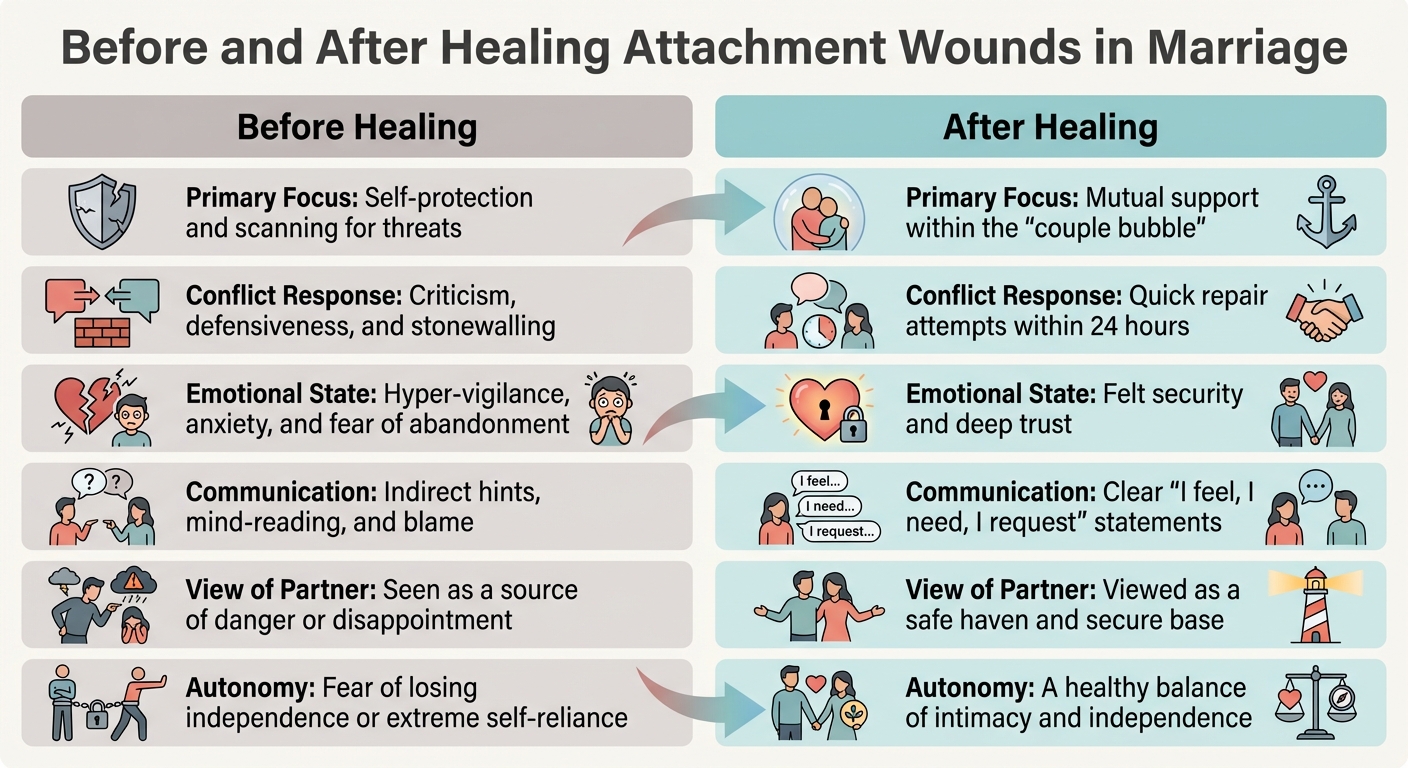
Before and After Healing Attachment Wounds in Marriage
When you work on healing attachment wounds, the positive changes in your marriage run deep. Instead of functioning as two individuals focused on self-preservation, you begin to operate as a unified team, prioritizing the strength and safety of your relationship. These changes naturally flow from the vulnerability, commitment, and open communication involved in the healing process. As Stan Tatkin beautifully puts it:
"We are built to heal each other – and to heal in the arms of another." [2]
This journey fosters what’s called a couple bubble – a secure and nurturing environment where both partners feel truly seen, heard, and safe [2]. You no longer find yourself constantly on edge, scanning for signs of rejection or feeling overwhelmed by closeness. Instead, you experience felt security, that deep, unshakable sense that your partner is consistently there for you [2].
Couples who successfully heal attachment wounds often maintain a ratio of at least five positive interactions for every negative one, creating a solid foundation of trust that can withstand inevitable conflicts [2].
Even your brain adapts during this process. With repeated positive experiences, old patterns of anxiety or withdrawal are replaced with calm, confident emotional responses [2]. Over time, you shift from reactive, knee-jerk emotions to thoughtful, intentional interactions [4].
For couples looking for tailored support on this transformative path, professional counseling – like the services offered by Growth and Change Counseling – can provide personalized guidance to help build and maintain these positive shifts.
Before and After Healing: A Comparison
The table below highlights the clear, tangible differences in a relationship before and after healing attachment wounds:
| Aspect | Before Healing | After Healing |
|---|---|---|
| Primary Focus | Self-protection and scanning for threats [2][5] | Mutual support within the "couple bubble" [2] |
| Conflict Response | Criticism, defensiveness, and stonewalling [4][3] | Quick repair attempts within 24 hours [2][4] |
| Emotional State | Hyper-vigilance, anxiety, and fear of abandonment [4][5] | Felt security and deep trust [2] |
| Communication | Indirect hints, mind-reading, and blame [4] | Clear "I feel, I need, I request" statements [4] |
| View of Partner | Seen as a source of danger or disappointment [6] | Viewed as a safe haven and secure base [6][1] |
| Autonomy | Fear of losing independence or extreme self-reliance [8][1] | A healthy balance of intimacy and independence [2][4] |
Conclusion
Healing attachment wounds isn’t about “fixing” something broken – it’s about rewiring your brain to create secure and lasting connections. Thanks to neuroplasticity, you and your partner can break free from harmful patterns and build what’s often called a "couple bubble." This bubble acts like a shield, offering safety and support as you navigate life’s challenges together [2]. Without this kind of focused effort, attachment injuries can grow over time, leading to ongoing conflict and emotional distance that can strain your marriage [9]. Understanding this lays the groundwork for taking meaningful steps toward rebuilding your bond.
Practical tools and strategies can help shift your relationship from one of self-protection to one of mutual care [2]. As Talya Cohen, PsyD, explains:
"Healing attachment wounds is not about erasing the past but rather learning how to navigate relationships with greater security and confidence" [8].
Seeking professional support can also play a key role in this healing process. Much like treating a physical injury, working with a professional can provide the structure and guidance needed to repair your attachment bond [9]. Growth and Change Counseling offers specialized services, including its 12-week Marriage Rescue Institute, designed to help couples overcome these challenges. With offices in Campbell, San Jose, Los Angeles, and Roseville, CA, along with telehealth options across California, support is within reach whenever you’re ready to take that next step.
The journey to healing begins with a choice: to confront the wounds rather than let them linger. With intentional effort, your marriage can become a secure and supportive foundation, meeting both partners’ needs for connection and safety [13].
FAQs
How can I recognize my attachment style and understand its impact on my marriage?
Understanding your attachment style and how it shapes your marriage starts with knowing the basics and reflecting on the dynamics of your relationship. The four primary attachment styles are: secure (comfortable with emotional closeness), anxious-preoccupied (characterized by a fear of abandonment and a strong need for reassurance), dismissive-avoidant (favoring independence and avoiding intimacy), and fearful-avoidant (a mix of wanting connection but fearing emotional pain). Recognizing which category fits you can shed light on how it influences your interactions with your spouse.
Take a closer look at recurring patterns in your relationship. Do you feel uneasy or anxious when your partner is busy or unavailable? Or perhaps you find yourself pulling away during disagreements? These tendencies can reveal how your attachment style manifests in your marriage. Keeping a simple journal of emotional triggers and your responses over a week or two can help you spot these patterns more clearly.
If pinpointing your attachment style feels challenging or you want to explore it further, seeking professional guidance can make a big difference. Therapists, such as those at Growth and Change Counseling, are skilled in helping couples uncover and address attachment-related challenges. With their support, you can develop practical tools to build a stronger, more connected partnership.
How can I create a safe emotional space with my spouse to strengthen our connection?
Creating a safe emotional space with your spouse is a cornerstone for building trust and addressing past emotional wounds. To start, focus on managing your own emotions before diving into sensitive discussions. Techniques like deep breathing or practicing mindfulness can help you stay calm and centered. When you’re ready to talk, use clear, non-blaming language to share your feelings and needs. For example, try saying, "I feel ___ when ___, and I need ___." This way, you can express yourself openly without triggering defensiveness.
Consistency plays a big role, too. Set aside regular times to check in with each other, making sure to listen actively – without interruptions – and acknowledge your partner’s emotions. Even small acts, like offering a kind word or a reassuring touch, can go a long way in creating emotional security. If things feel too challenging to navigate on your own, reaching out to Growth and Change Counseling can provide personalized strategies to help you and your spouse rebuild trust and strengthen your connection.
When should we seek professional help to address attachment wounds in our marriage?
If attachment wounds are leaving you with persistent feelings of betrayal, abandonment, or emotional disconnection in your marriage, it might be time to consider professional help. This can also be a wise step if unresolved conflicts keep resurfacing or if your attempts to mend the relationship aren’t making a noticeable difference.
A qualified professional can offer effective tools, strategies, and guidance to help you and your partner rebuild trust and deepen your emotional bond. Taking this step can feel daunting, but with the right support, healing and growth are absolutely within reach.
Related Blog Posts
- Attachment Styles in Couples Counseling
- Relationship Trauma: Root Causes and Solutions
- Trauma Recovery for Couples: A Path to Healing
- How Attachment Styles Affect Addiction Recovery in Couples
