Trauma affects not just individuals but entire families, disrupting routines, relationships, and emotional bonds. Trauma-informed family therapy focuses on understanding the root causes of behavior, prioritizing safety, and rebuilding trust within the family. Key approaches include:
- Trauma-Focused Cognitive Behavioral Therapy (TF-CBT): Structured sessions to address trauma narratives and improve emotional regulation.
- Emotionally Focused Family Therapy (EFFT): Strengthens emotional connections by addressing attachment wounds.
- Parent-Child Interaction Therapy (PCIT): Live coaching for caregivers to improve parenting strategies and reduce behavioral issues.
Core principles include safety, empathy, and collaboration. Techniques like psychoeducation, grounding exercises, and consistent routines help families navigate trauma together. By addressing both individual and relational dynamics, families can rebuild trust and improve communication, paving the way for healing and resilience.
What Trauma-Informed Approaches Boost Family Coping?
Core Principles of Trauma-Informed Care in Families
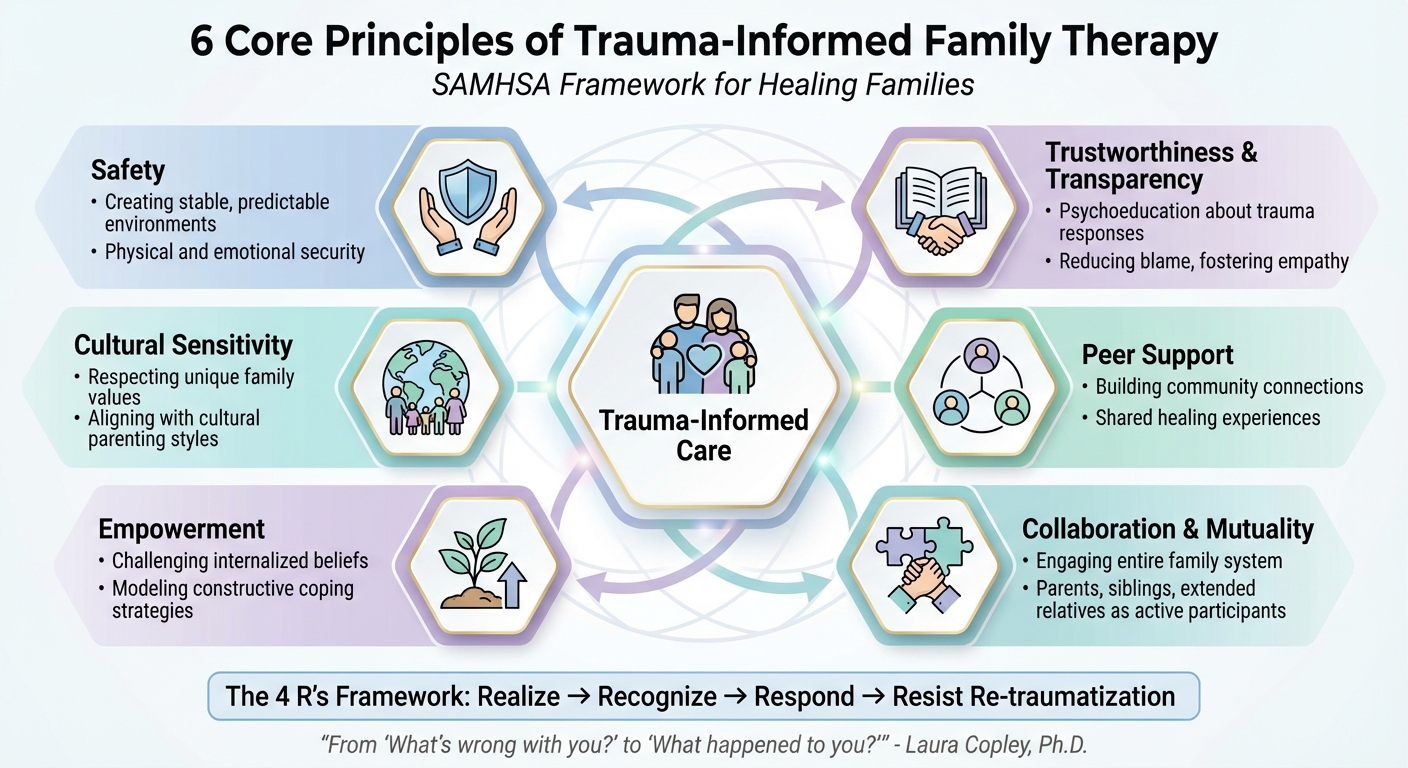
6 Core Principles of Trauma-Informed Family Therapy
The Substance Abuse and Mental Health Services Administration (SAMHSA) identifies six key principles that form the foundation of trauma-informed family therapy: safety, trustworthiness and transparency, peer support, collaboration and mutuality, empowerment, and cultural, historical, and gender considerations [2]. These principles shape how therapists interact with families throughout the therapeutic process.
Another helpful framework is the "4 R’s" of trauma-informed care. This system emphasizes that a trauma-informed approach must: realize the far-reaching effects of trauma, recognize its signs and symptoms in both individuals and families, respond by integrating trauma-awareness into every aspect of practice, and actively work to resist re-traumatization [2]. This framework highlights how trauma impacts family dynamics and relationships.
Safety goes beyond physical protection; it involves creating a stable and predictable environment where family members feel comfortable expressing themselves openly [3]. Trustworthiness is cultivated when therapists provide psychoeducation, helping parents understand that behaviors like anger or withdrawal in their child are often physiological responses to trauma – not acts of defiance. This understanding helps reduce blame and fosters empathy [3]. Collaboration involves engaging not just the individual but the entire family – parents, siblings, and even extended relatives – as active participants in the healing process [1][3].
Empowerment plays a critical role by helping family members challenge internalized beliefs such as "I’m unworthy of love" and guiding caregivers to model constructive coping strategies [3]. Additionally, cultural sensitivity ensures that therapeutic interventions respect and align with a family’s unique values, parenting styles, and ways of understanding trauma [3]. As Laura Copley, Ph.D., explains, trauma-informed therapy shifts the focus from "what’s wrong with you" to "what happened to you" [4].
Key Trauma-Informed Techniques for Family Therapy
Building on foundational principles, specific therapeutic approaches address the ways trauma impacts family dynamics. Research shows that trauma is a widespread issue among children in the United States, with at least two-thirds of American children and adolescents experiencing at least one traumatic event. Alarmingly, about 33% face multiple traumas before adulthood [6].
Trauma-Focused Cognitive Behavioral Therapy (TF-CBT)
TF-CBT is a structured treatment model where both parents and children participate in parallel individual sessions, eventually coming together for joint sessions. Judith A. Cohen, M.D., describes it as:
Trauma-focused CBT is a family-focused treatment in which parents or caregivers… participate equally with their traumatized child or adolescent [6].
This method follows a clear framework, including psychoeducation, relaxation strategies, emotional regulation, cognitive processing, trauma narrative creation, in vivo mastery, joint sessions, and safety planning.
During the stabilization phase, families work to identify triggers – such as specific smells or sounds – that cause stress. For cases involving complex trauma, this phase often takes up about half the treatment time, typically 8–12 sessions out of a total of 16–25. Parents are guided to offer immediate, specific praise without pairing it with criticism. In the trauma narration and processing phase, children develop a trauma narrative while parents address their own emotional responses separately. Finally, the integration phase brings the family together to collaboratively process the trauma narrative, fostering improved communication and understanding. Standard TF-CBT generally takes 12–15 sessions, though more complex cases may require 16–25 sessions [6].
While TF-CBT focuses on trauma narratives, other approaches like EFFT aim to repair emotional bonds.
Emotionally Focused Family Therapy (EFFT)
EFFT centers on healing attachment wounds by helping families understand and shift emotional patterns that shape their relationships. This approach is particularly helpful when trauma has weakened the parent-child bond, sometimes causing caregivers to unintentionally repeat their own trauma responses. Therapists guide families to identify harmful patterns while creating emotional safety through empathetic listening and validation. Taylor Mayman from the Department of Biobehavioral Health highlights the importance of this:
Safety is paramount in trauma therapy, and EFFT emphasizes creating a secure environment for family members to explore their emotions and discuss difficult topics [3].
This method helps families rebuild emotional connections, laying the groundwork for long-lasting healing.
Parent-Child Interaction Therapy (PCIT)
PCIT is tailored for young children (ages 2 to 7) who struggle with behavioral issues such as aggression, defiance, and emotional dysregulation. This evidence-based approach uses live coaching, where therapists provide real-time guidance to caregivers through an earpiece, enabling them to immediately apply positive parenting strategies. PCIT International explains:
PCIT stands out for its live coaching model… This hands-on approach helps parents apply positive parenting strategies with confidence and effectiveness [7].
The therapy consists of two phases. In the Child-Directed Interaction (CDI) phase, parents follow their child’s lead during play to foster warmth and a secure bond. In the Parent-Directed Interaction (PDI) phase, parents learn to set clear boundaries and enforce consistent limits. Caregivers are also encouraged to dedicate "Special Time" – a daily five-minute session of child-led play – to further strengthen their connection. Studies have shown that PCIT effectively reduces instances of low to moderately severe physical abuse by replacing coercive parenting behaviors with positive interaction patterns [8]. The National Child Traumatic Stress Network underscores this, stating:
The parent-child relationship is vital to the child’s development and recovery. Parents’ protection, nurturance, and guidance speeds recovery [1].
sbb-itb-596b85d
The Role of Psychoeducation and Parenting Skills
Psychoeducation plays a key role in helping families grasp how trauma shapes daily life. When parents understand that behaviors like anxiety, anger, or withdrawal are rooted in trauma responses rather than intentional misbehavior, they can approach their children with empathy instead of frustration. Taylor Mayman from the Department of Biobehavioral Health at The Pennsylvania State University puts it this way:
"Psychoeducation helps to normalize the child’s symptoms (such as anxiety, anger, or withdrawal) and helps family members recognize how their reactions to the child’s behavior may inadvertently contribute to the cycle of trauma." [3]
This knowledge reduces blame within families, fostering an environment where healing can happen collaboratively. Parents learn how trauma impacts brain development and behavior, especially in children, which sheds light on why managing emotions can be so difficult. It also helps families understand that reactions to the same traumatic event can vary depending on factors like age, developmental stage, and personal connection to the event. This awareness can prevent misunderstandings and encourage patience [1].
Building on this foundation, parenting skills provide caregivers with actionable strategies to support their children. These skills offer tools to promote healing by focusing on protection, nurturing, and guidance. For example, maintaining consistent routines helps reinforce a sense of safety, while shared calming activities, known as co-regulation, strengthen emotional connections between parents and children.
In the United States, about 50% of children – roughly 35 million – experience at least one type of trauma before the age of eight [9]. Trauma can drain family resources and disrupt communication patterns. Psychoeducation helps families recognize these challenges, enabling them to manage stress more effectively and break harmful cycles that might otherwise persist across generations [3].
When combined with therapy, psychoeducation and parenting strategies create a powerful framework for recovery. For families seeking personalized support, Growth and Change Counseling incorporates these evidence-based approaches to build resilience and improve communication within the family unit.
Building Safety and Improving Family Communication
When it comes to helping families heal from trauma, creating a safe and supportive environment is essential. Safety is the cornerstone of trauma recovery. Before tackling deeper emotional wounds or rebuilding strained relationships, families must establish a space where everyone feels secure and protected. As Laura Copley, Ph.D., puts it:
The primary focus is creating a physically and emotionally secure environment… to help survivors regain control and trust [4].
This involves setting up predictable routines, respecting boundaries, and ensuring that home feels like a sanctuary, not a source of stress. Such an environment lays the groundwork for meaningful and healing family conversations.
How families approach conversations about trauma plays a crucial role in recovery. For instance, when a child exhibits challenging behavior, shifting the question to "What happened to you?" instead of "What’s wrong with you?" encourages empathy and understanding rather than blame [4]. Imagine a child refusing to attend school – this could be less about defiance and more about an underlying traumatic experience. Recognizing this opens the door to providing the right kind of support.
Once a secure environment is established, communication strategies can further strengthen family bonds. Communication breaks down when individuals feel unheard. To avoid this, families can use tools like "I" statements, which help defuse tension and foster connection. For example, saying "I feel frustrated when I’m interrupted" encourages dialogue, whereas "You never listen to me" can escalate conflict [10][11]. Active listening, where you paraphrase what someone has said before responding, ensures that everyone feels genuinely heard. Dr. Matthew Loux and Bryce Loux from American Military University emphasize:
Effective communication does not mean a family has to avoid arguments or say the right thing all the time. To communicate effectively, the challenge is to develop a structure of trust, openness, and respect that enables every family member to feel appreciated and understood [10].
In addition to open communication, daily rituals can help anchor families during difficult times. The National Child Traumatic Stress Network notes:
When families carry out routines, rituals, and traditions, they strengthen their connections and grow stronger together [1].
Simple activities like shared meals, family meetings, or bedtime conversations create moments of connection and foster resilience.
To complement a safe home environment, grounding techniques can be invaluable for managing intense emotions and improving communication. With approximately 70% of adults in the United States having experienced at least one traumatic event [5], many families are navigating the effects of trauma. Grounding exercises, such as deep breathing or progressive muscle relaxation, help family members calm their nervous systems when emotions run high [4]. For families looking for additional support, Growth and Change Counseling offers therapy services designed to help rebuild trust and strengthen family bonds using trauma-informed approaches.
Conclusion
Trauma-informed family therapy provides a meaningful path to healing attachment wounds by addressing the family system as a whole. By weaving together trauma theory, attachment principles, and family dynamics, this approach acknowledges how traumatic experiences can disrupt trust and emotional connections across generations. It builds on the techniques discussed earlier to create a framework for recovery. As Taylor Mayman from Pennsylvania State University explains:
By focusing on both individual healing and collective recovery, TFFT offers a comprehensive approach that promotes the overall well-being of the family unit and disrupts the intergenerational transmission of trauma [3].
Therapists trained in trauma-informed methods help families safely navigate painful emotions, rebuild trust, and develop healthier communication patterns. When children feel safe to express vulnerabilities and parents respond with empathy and understanding, negative cycles can shift toward secure attachment bonds that nurture long-term emotional health.
For families working through the challenges of trauma recovery, professional guidance plays a crucial role. Targeted support helps solidify the healing process and ensures families stay on track. Growth and Change Counseling offers family therapy services aimed at rebuilding trust, strengthening relationships, and breaking cycles of dysfunction. With offices in Campbell, San Jose, Los Angeles, and Roseville, CA, as well as telehealth options throughout California, professional help is within reach for families ready to heal together.
As highlighted by the National Child Traumatic Stress Network:
The parent-child relationship is vital to the child’s development and recovery. Parents’ protection, nurturance, and guidance speeds recovery and supports their children’s coping in the face of trauma [1].
This reinforces the importance of a unified, well-supported approach to family healing. With commitment to collaborative efforts and professional care, families can restore emotional balance, build resilience, and create lasting positive change for everyone involved.
Start Your Healing Journey with Growth and Change Counseling
How does psychoeducation support healing in trauma-informed family therapy?
Psychoeducation plays a critical role in trauma-informed family therapy, offering families a clearer picture of how trauma affects emotions, behaviors, and relationships. By sharing age-appropriate, straightforward information, therapists help children and caregivers better understand common trauma responses. This approach not only normalizes their experiences but also instills a sense of hope for recovery.
When families gain this shared understanding, it can significantly reduce blame, misinterpretations, and unnecessary conflicts. Having a common language to discuss symptoms and behaviors encourages empathy and teamwork, enabling families to face challenges together. At Growth and Change Counseling, psychoeducation is seamlessly woven into therapy sessions, equipping families with the knowledge and tools they need to heal, communicate more effectively, and strengthen their bonds.
What makes Parent-Child Interaction Therapy (PCIT) different from other trauma-informed approaches?
Parent-Child Interaction Therapy (PCIT) takes a different approach compared to many trauma-informed methods. Instead of focusing on the child’s traumatic memories, it centers on real-time coaching to improve the caregiver-child relationship. During sessions, therapists guide parents live – often through a headset – teaching them how to foster positive interactions and use effective discipline techniques. The goal? To strengthen the parent-child bond while addressing behavior issues.
What makes PCIT stand out is its emphasis on caregiver involvement. Unlike therapies that focus solely on the child or leave caregivers out of the process, PCIT keeps parents actively engaged every step of the way. For situations where trauma requires more direct attention, therapists can incorporate Trauma-Directed Interaction (TDI). This adaptation adds trauma education and tools to help manage triggers, making the therapy even more effective. By combining live coaching with a strong caregiver role, PCIT offers a unique path to healing within the family dynamic.
Why is creating a safe environment essential for families healing from trauma?
Creating a safe and steady environment plays a key role in trauma recovery. Trauma often shakes a person’s sense of security, so rebuilding that foundation is essential. When family members feel both physically and emotionally safe, they’re more likely to open up about their experiences and emotions. This openness strengthens trust and nurtures healthier relationships. It also helps with emotional regulation and clearer communication – both critical pieces of the healing process.
In a secure space, caregivers can engage more fully in therapy, demonstrate positive coping techniques, and reinforce progress within the home. This teamwork not only minimizes the chances of setbacks but also helps families build resilience, giving them the tools to face and work through trauma together. Growth and Change Counseling embraces these values in family therapy, offering a calm, supportive setting where every family member feels respected and ready to begin their healing journey.
Related Blog Posts
- How Family Therapy Restores Trust After Addiction
- Trauma and Depression in Marriage: Key Connections
- Trauma Recovery for Couples: A Path to Healing
- How Trauma Impacts Parent-Child Relationships
